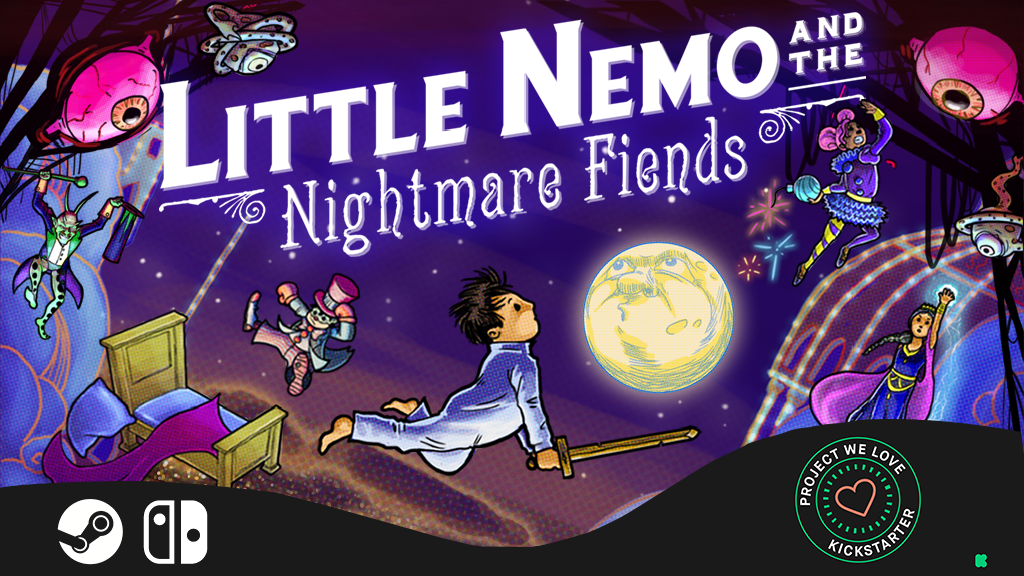
An indie game based on Winsor McCay's groundbreaking comic strip.
Latest Updates from Our Project:
Weekly Brainstorm Podcast #2 & Other Projects to Follow
over 5 years ago
– Tue, Mar 16, 2021 at 11:35:30 PM
This post is for backers only. Please visit Kickstarter.com and log in to read.
50% funded and other updates!
over 5 years ago
– Mon, Mar 15, 2021 at 11:51:09 PM
Good evening dreamers!!!!
Today was an excellent day that started off strong when we crossed the 50% threshold and continued to gain throughout the day! At this point we're past 50%, but we thought we'd make some brand new artwork to celebrate the milestone regardless, featuring a better look at our villains, the Nightmare Fiends (and of course our friend the King Frog enjoying some candy!)
What's coming up...
This is going to be a busy week. We're going to have the usual fanfare - podcast tomorrow, Artwork Wednesday, etc. We'll also have an update on the design of Peony from her creator, Taja Emmanus.
We'll also have some things to announce in the coming days about music! We have a brilliant composer that we can't wait to introduce you to. We might also have other musical surprises in store, so stay tuned...
Not funded yet...
Now obviously this is great, but we're not funded yet, and Kickstarter is still all or nothing! We still need to charge ahead (like Little Nemo and friends on the bed up there!) If you can, please please continue spreading the word about the campaign anywhere you can! We've had a lot of luck getting in front of new backers in the last few days (hello new folks!) so we need to keep it up to make the game a reality! Sharing tweets like this one (https://twitter.com/PFBStudios/status/1371500405885177857) really help us a lot! We can do it!
Oh...one more thing...
We're unlocking gold costumes for all playable characters and Steam Early Access for all backers with the game as thanks for helping us reach 50%! We'll make announcements after the campaign as to the timeline of that rollout, but please look forward to doing your early access streams in STYLE!
Cheers and many many thanks for believing in our game!
Team Nemo
Sunday Funnies: The Architecture of Little Nemo
over 5 years ago
– Sun, Mar 14, 2021 at 11:36:49 PM
Happy Sunday everyone!
Today I thought I'd talk about one of the aspects of LittleNemo that's near and dear to my heart: the architecture of Slumberland. I've mentioned this in other posts, before I was a game developer I studied architecture. I discovered Winsor McCay's Little Nemo comics when I was looking up "that game that I really liked as a kid" and found these comics with amazingly rendered environments.
Little Nemo in Slumberland from March 4, 1906. Flip's first appearance occurs against a richly detailed Beaux Arts setting. (Source: Comic Strip Library)
Inspirations
Winsor McCay's Slumberland is a land of dreams, but also a showcase of popular architecture of the time. At the time, one of the most recent projects in the popular consciousness was the 1893 Chicago Columbian Exposition, overseen by architects John Wellborn Root, Daniel Burnham, and Charles B. Atwood, and landscape architect Frederick Law Olmsted.
The main canal of the 1893 Columbian Exposition, with a statue, The Republic, in the foreground and the Administration Building in the center. (Source: Wikipedia)
The Exposition (also known as the Chicago World's Fair) was a huge complex of buildings built in the Beaux Arts style, emphasizing neoclassical elements (columns, Greek-style temple elements, etc.), symmetry, and built to give off a sense of splendor. The fair was a major event in popular culture: among the inventions and innovations first seen there were squashed (stretched) pennies, Cream of Wheat, a device for printing books in Braille, Pabst Blue Ribbon Beer (the blue ribbon is the one it earned at the Fair), and the Ferris Wheel, among many others. It even saw a performances by Harry Houdini. The Exposition ran for 6 months and was attended by 27 million people. The Fair's sights reached even farther, with photos and engravings being sold widely on souvenir cards. Whether McCay himself attended the fair is not clear, but he would have likely known about it from popular media of the time.
The June 6, 1909 Little Nemo in Slumberland Strip, showing Slumberland's monumental architecture rising up from the ground. Viewed from far away, parts of this comic can be read as one continuous image of a piece of architecture. (Source: Comic Strip Library)
Another architectural influence on McCay was closer to home: Coney Island's Luna Park (the original 1903 version). Like the Columbian Exposition, Luna Park featured fantasy architecture collected around a large canal. It informed many of the buildings in McCay's comics and has been credited with influencing the skylines of Slumberland.
Coney Island's Luna Park at night. Winsor McCay would have been able to travel to this park easily from his house in Sheepshead Bay, NY.
A frame from the December 17 1905 Little Nemo in Slumberland Strip, showing the amusement park-influenced skylines of Slumberland (Source: Comic Strip Library)
What if?
So far throughout the project, we've taken a lot of cues from McCay himself, utilizing Beaux Arts influences in the architectural and visual style of Little Nemo and the Nightmare Fiends. Some of our earliest concept art, for example, includes images from both the comic and the Columbian Exposition.
A concept art comic based on the "rising Slumberland" comic above. Viewed from far away, this comic is literally a building elevation of one of the buildings from the Columbian Exposition. In this comic, each of the characters show off their different powers (Flip's swing was not created yet.)
The architecture that influenced McCay was not the only architecture being built at the time, though. In our approach to Slumberland, we try to imagine what Nemo's dream world might have been like if McCay (or Nemo himself - he's the dreamer!) were exposed to other architectural works from his era. One such influence is a favorite of mine, Catalan architect Antoni Gaudi (1852-1926). Gaudi's work includes Basilica de la Sagrada Familia, Park Güell, and Casa Batlló in Barcelona, Spain (among others.) Gaudi's architecture was heavily inspired by nature. Though Gaudi's style is all his own, it has been linked to the Art Nouveau movement influential to McCay's own style. For this reason, we tried to imagine several elements of our Slumberland using elements from Gaudi's works, such as his organic-shaped columns.
The interior of Sagrada Familia, whose construction began in 1882. The church, while functional, has not yet been completed. The current estimate for completion is 2026. (source: Wikipedia)
In the comics, Jack Frost's Palace is visually similar to Slumberland, so we took influences from Gaudi (the galleries and columns from Sagrada Familia, other columns from Park Güell) to give the level its own character.
As we continue to develop the game's environments, we'll dig even further into our bag of architectural references to give the various worlds of Slumberland their own visual character and an even dreamier, surreal look.
That's it for this edition of Sunday Funnies! We hope you enjoyed this look at the architecture of LittleNemo!
We'll see you in the funny papers!
Chris and Team Nemo
Development Stream Saturday
over 5 years ago
– Sun, Mar 14, 2021 at 01:47:04 AM
This post is for backers only. Please visit Kickstarter.com and log in to read.
Backers Only: The tools of Little Nemo's non-linear level design
over 5 years ago
– Fri, Mar 12, 2021 at 11:04:25 PM
This post is for backers only. Please visit Kickstarter.com and log in to read.
We use essential cookies and our own first-party analytics to run BackerKit. With your consent, we also use cookies to measure our marketing and share data with advertising partners to show you relevant ads. Accept to allow all cookies, or reject to turn off the optional ones.
Read our cookie policy.